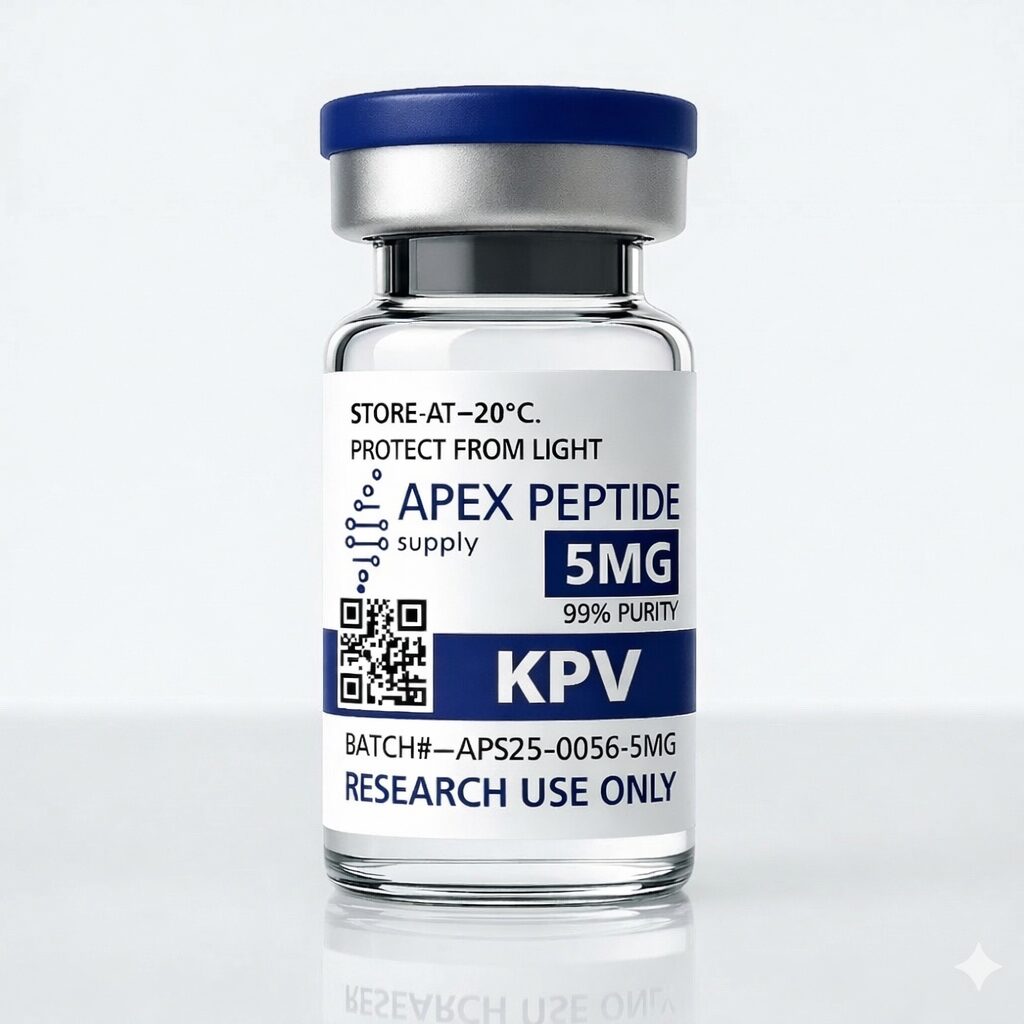
Product Information & Reference Guide
Welcome to the official technical specification and product information overview. This comprehensive reference manual provides clinical researchers, laboratory technicians, and academic institutions with essential data regarding the handling, storage, quality protocols, and operational standards of our high-purity KPV.
1. Regulatory Status of KPV
All KPV distributed by Apex Peptides is manufactured, synthesized, and supplied strictly for in vitro laboratory research and academic study. This specific material is not intended for human consumption, therapeutic use, diagnostic procedures, or veterinary applications of any kind.
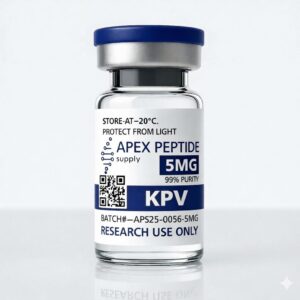
By conducting investigations with this peptide, researchers must ensure full compliance with localized institutional review boards (IRBs), environmental health and safety (EHS) guidelines, and federal laboratory regulations. All chemical properties, molecular weights, and structural sequences of KPV are detailed on individual product vials and corresponding documentation to ensure precise analytical replication and adherence to strict laboratory compliance.
2. Uncompromising Quality Assurance for KPV
The integrity of scientific research relies entirely on the precision of the underlying materials. To eliminate experimental variables and false data points, Apex Peptides enforces a rigorous multi-stage quality control protocol on every batch synthesized in the USA.
HPLC Testing Standards
Every batch undergoes High-Performance Liquid Chromatography (HPLC) testing to verify structural identification and purity levels. We maintain a strict baseline requirement, ensuring that the synthesized KPV achieves a minimum purity rating of 98% to 99%+. This demanding process isolates and identifies any potential organic impurities, ensuring they fall well below acceptable analytical thresholds for high-level scientific inquiry.
Mass Spectrometry (MS) Analysis
Mass spectrometry is utilized in tandem with HPLC to confirm the exact molecular weight and mass-to-charge ratio of the synthesized sequence. This guarantees that the delivered material matches its theoretical chemical formula perfectly, preventing cross-contamination or structural degradation during the complex lyophilization phase.
3. Laboratory Handling & Reconstitution
To maintain structural integrity during reconstitution, precise laboratory protocols must be executed by trained personnel. Sudden mechanical stress or incorrect solvent selection can result in rapid denaturing of the fragile peptide bonds.
Recommended Reconstitution Protocol for KPV
-
Equilibrate: Allow the lyophilized vial to naturally reach room temperature (20°C to 25°C) before introducing any solvent. This prevents condensation from forming inside the vial, which can prematurely degrade the powder.
-
Solvent Selection: Use sterile Bacteriostatic Water (0.9% Benzyl Alcohol) or sterile Normal Saline (0.9% NaCl) depending on your specific KPV protocol requirements and cellular application.
-
Gentle Introduction: Clean the rubber stopper with an isopropyl alcohol wipe. Direct the fluid stream down the inside glass wall of the vial rather than spraying it directly onto the delicate lyophilized cake.
-
Dissolution: Do not shake or agitate the vial vigorously. Shaking causes extreme mechanical shear stress. Instead, gently swirl the vial in a smooth circular motion until the powder is fully dissolved into a perfectly clear, translucent solution.
4. Storage Matrix & Longevity
Lyophilized and reconstituted KPV exhibits varying degrees of stability depending on environmental factors like temperature fluctuations, ultraviolet (UV) exposure, and ambient moisture.
| Form | Storage Temperature | Estimated Stability |
| Lyophilized Powder (Room Temp) | 15°C to 25°C | Up to 90 Days (Transit Only) |
| Lyophilized Powder (Refrigerated) | 2°C to 8°C | 12 to 24 Months |
| Lyophilized Powder (Deep Freeze) | -20°C to -80°C | Up to 5 Years |
| Reconstituted Solution | 2°C to 8°C | 21 to 28 Days |
Crucial Environmental Protections
Keep all vials stored in their original packaging or dark containers at all times. Direct UV light exposure triggers immediate photolytic degradation, permanently compromising the chemical composition of KPV. Avoid storing lyophilized vials in standard household “frost-free” freezers. These specific units undergo automatic temperature spikes to melt internal ice, and these constant temperature fluctuations will rapidly degrade delicate chemical bonds.
5. Secure Procurement
Apex Peptides is completely committed to providing a streamlined, highly secure supply chain to support ongoing scientific advancements across the United States. To safeguard institutional data and financial transactions, our store features fully encrypted checkout pipelines supporting secure cryptocurrency payments. This guarantees private, immutable verification for all acquisition logs. Orders of KPV are packaged in secure, temperature-controlled, cushioned parcels to mitigate mechanical shock during transit, ensuring all items arrive well within safe environmental tolerances.